

Artificial Intelligence Transforming University Learning

The landscape of higher education is undergoing a fundamental shift. Artificial intelligence has transitioned from experimental pilots to integrated learning systems across universities worldwide, particularly in Singapore's leading institutions. For corporate executives, entrepreneurs, and investors evaluating the future of workforce development and talent acquisition, understanding this transformation is critical to strategic planning and competitive positioning.
AI Moving Beyond the Classroom

Universities are deploying AI tools at scale to address longstanding educational challenges. The evidence is emerging from real implementations rather than theoretical projections. National University of Singapore (NUS) law students now use AI chatbots to practise cross-examinations in trial advocacy courses. Since March 2024, these tools have enabled students to simulate realistic courtroom scenarios—ranging from difficult witnesses to demanding judges—without the psychological pressure of immediate peer evaluation. Over 126 students have benefited from this single application alone.
At Nanyang Technological University's Lee Kong Chian School of Medicine, Anatbuddy, an AI anatomy chatbot introduced in November 2024, has helped first- and second-year students move beyond rote memorization. Rather than simply naming anatomical parts, students engage with clinical "what if" scenarios—exploring not just where something is located, but what it does and what happens when it's damaged. This shift from passive recall to active problem-solving represents a fundamental change in how foundational knowledge translates to professional capability.
What's noteworthy for business strategists is that these implementations directly address workforce readiness gaps. The students emerging from these AI-enhanced programs will enter the job market with different skill profiles than their predecessors—individuals who have developed critical thinking through interaction with intelligent systems rather than through traditional lecture-based passive absorption.
Efficiency and Scale
The operational benefits are not merely pedagogical—they directly impact institutional economics. McKinsey research indicates that automating routine administrative tasks in higher education can reduce costs by up to 30%. For universities managing tight budgets and competing for international talent, this efficiency gain is substantial.
More importantly, AI-assisted learning scales personalization in ways that were previously impossible. At Singapore Management University, a design thinking bot has served nearly 400 students from the School of Computing and Information Systems, engaging them as stakeholders in real-world problem scenarios. The bot doesn't replace human instructors; rather, it augments them by handling the labour-intensive work of iterative feedback and scenario exploration.
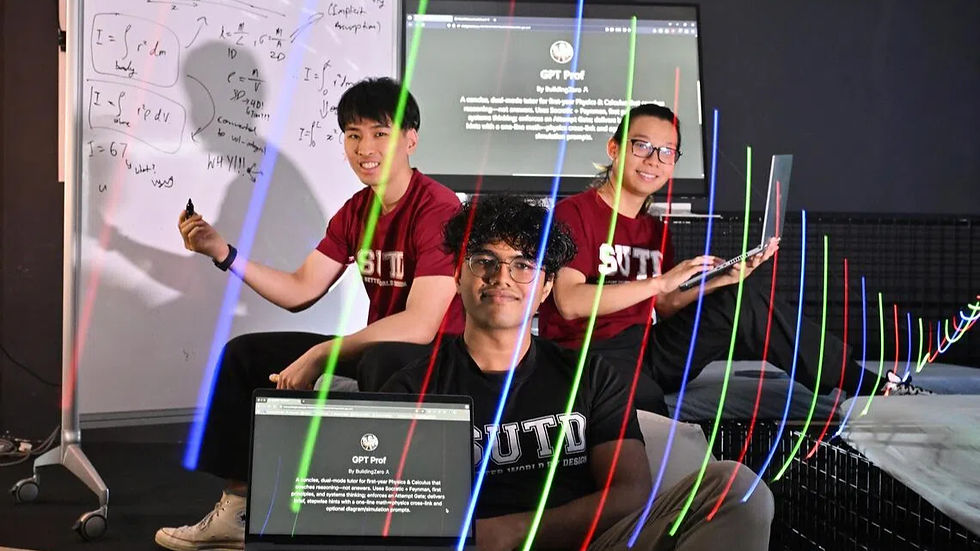
A group of undergraduates at Singapore University of Technology and Design took this further. They created GPTBernie—an AI tutor modelled on their professor Bernard Ee's teaching style—which they developed the day before a mathematics final. This initiative eventually expanded into a library of "GPTProfs," tools developed entirely by students to support one another. The business implication here is significant: AI isn't something institutions impose on learners from above. Forward-thinking institutions create conditions where learners become co-creators of their own learning infrastructure.
Beyond Hard Skills

Corporate hiring managers report consistent feedback: universities traditionally produce graduates with subject expertise but often lacking in practical problem-solving ability, communication skills, and ability to operate within realistic constraints. AI-enhanced learning addresses this gap more effectively than traditional approaches for one simple reason—it simulates real conditions.
When NUS law students practice cross-examinations with an AI judge, the system actually overrules them when they ask leading questions. The feedback is immediate, precise, and based on actual procedural rules, not instructor interpretation. This teaches not just legal theory but practicum-level competency. Year 3 law student Emmanuel Wong noted that the "judge" corrects improper questioning in ways peers might miss, directly preparing students for courtroom realities.
Similarly, at Singapore University of Social Sciences, the iSmartGuide platform has served over 22,000 students since launching in June 2025, delivering bite-sized lessons, flashcards, and quizzes. For employers, this matters because graduates have experienced continuous assessment and adaptive learning—they understand their knowledge gaps and have practiced working through them. They're not discovering deficiencies on the first day of employment.
This Is Not Job Replacement
Understandably, some stakeholders worry that AI-enhanced learning might diminish the value of human educators or create dependency on technology. The evidence from Singapore suggests the opposite dynamic is occurring.
At NUS, the chatbot practice reduced psychological pressure and allowed students to build confidence before live interactions. Associate Professor Mervyn Cheong, who helped develop the tool, noted that students who first practise in their own space, free from the anxiety of peer observation, later perform better in high-stakes situations. The technology doesn't replace the instructor—it makes the instructor more effective by shifting one-on-one time toward advanced concepts rather than basic scaffolding.
Dr Ranganath Vallabhajosyula from NTU's Medical School describes the balance as strategic: AI can handle foundational learning quickly, allowing students to allocate more time and effort to advanced concepts. The key, he emphasises, is ensuring students "take ownership of their learning" rather than outsourcing critical thinking. This requires educators who understand both the technology and the pedagogical risks—a role that demands more expertise, not less.
The Research-Productivity Connection
One underappreciated dimension of AI in universities is its impact on research capability. Rileybot, deployed at NTU's medical school since January, guides students through literature database searches with greater precision than general-purpose AI tools. Over 500 students have used this tool. For medical research—where accurate citation and comprehensive literature review are foundational—this matters enormously.
From a business perspective, universities that can teach students to conduct research more efficiently and comprehensively are producing graduates better equipped for evidence-based decision-making in professional roles. The skill of navigating information, evaluating sources critically, and synthesising findings across domains is increasingly valuable across sectors, from finance to policy to product development.
Cultural and Strategic Considerations
Importantly, these implementations don't happen automatically. They require institutional commitment, faculty engagement, and thoughtful design. Singapore's universities have moved relatively quickly compared to many global peers, suggesting several enabling factors: institutional agility, access to technical talent, and cultural openness to innovation.
However, the transition also reveals challenges. Studies on AI adoption in higher education consistently identify concerns around academic integrity, algorithmic bias, and ensuring equitable access to technology. Universities implementing these systems report needing significant investment in faculty training, clear governance frameworks, and ongoing monitoring of outcomes.
For investors and corporate strategists considering talent pipeline investments or partnerships with universities, this is important context. Institutions investing thoughtfully in AI-enhanced learning—with clear boundaries, ethical frameworks, and commitment to human-centred design—are likely to produce stronger graduate cohorts. Those rushing to deploy technology without structural support tend to encounter friction and diminished returns.
Sustainable Integration Matters
The distinction between institutions that are thoughtfully integrating AI and those simply adopting technology for adoption's sake is becoming clearer. Universities in Singapore demonstrating success emphasise several consistent elements: clear alignment between AI tools and learning objectives, significant faculty involvement in design rather than technology-driven mandates, attention to equity and access, and commitment to ongoing assessment of outcomes.
For business leaders evaluating university partnerships, talent pipelines, or workforce development investments, these characteristics are indicators worth assessing. Institutions that treat AI as a tool to amplify human teaching and learning—rather than a replacement—tend to produce graduates with stronger foundational skills, greater adaptability, and more thoughtful approaches to technology adoption.
The transformation of university learning through artificial intelligence is well underway. How individual institutions navigate this shift will significantly influence the capability and readiness of the talent they produce.


